ChatGPT vs Google in 2026: How Businesses Get Found
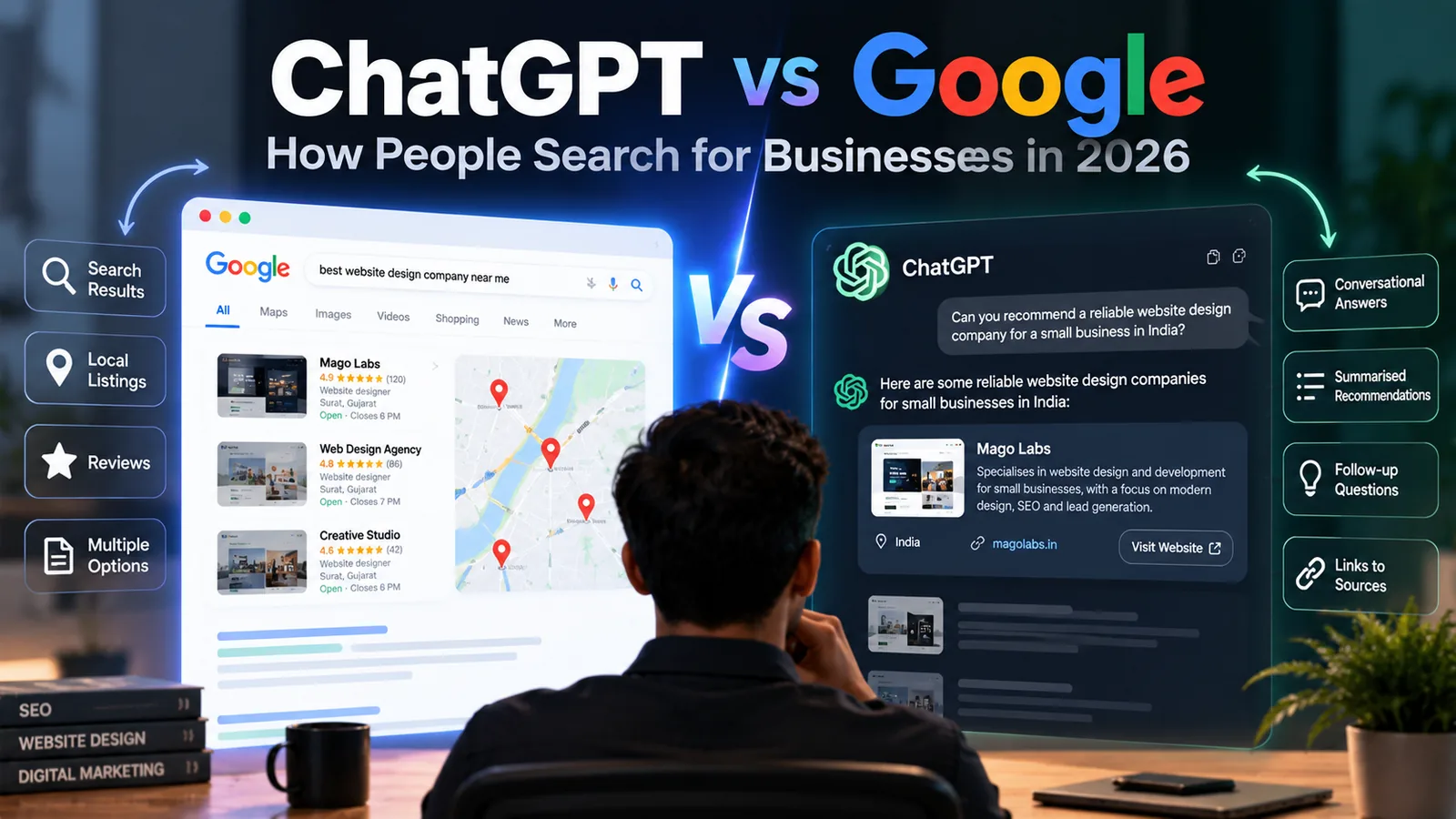
For years, Google has been the first place people go when they need a product, service, or answer.
Need a plumber? Search Google. Looking for a website designer? Search Google. Want to compare local businesses? Open Google Maps and read reviews.
But something is changing.
People are increasingly using AI tools such as ChatGPT to ask questions, explore options, compare services, and get recommendations. Instead of searching for a list of websites, they can ask a question and receive a conversational answer.
This raises an important question for business owners:
Will potential customers find your business on Google, through ChatGPT, or both?
Understanding the difference can help you make better decisions about your website, content, and online visibility.
1. How Google Search Works
Google helps people discover information by displaying relevant web pages, local listings, images, videos, and other results.
For example, someone searching for “best website designer in Melbourne” might see:
Website design agencies
Google Maps business listings
Customer reviews
Organic search results
Sponsored advertisements
Related questions and other content
The searcher can compare several options before visiting a website or contacting a business.
For businesses, visibility often depends on factors such as relevance, content quality, website accessibility, competition, local signals, and the authority of the website.
This is why search engine optimisation, commonly known as SEO, remains important.
A well-designed website that explains your services clearly, provides useful information, and offers a good mobile experience gives potential customers a better reason to engage with your business.
However, simply having a website does not guarantee that Google will rank it highly.
2. How ChatGPT Search Is Different
ChatGPT offers a different way to discover information.
Instead of typing a short phrase, a user might ask:
“Can you recommend a reliable website design agency for a small construction company in Sydney?”
Depending on the tools and search features available in that conversation, ChatGPT may provide an answer that summarises relevant information and, when web search is used, include links to sources.
This changes how people interact with information.
A traditional search might lead someone to compare ten websites. An AI-assisted search may help them narrow their options before visiting any website.
For businesses, this creates another opportunity to become visible when potential customers are researching a purchase or service.
However, there is an important distinction: ChatGPT does not recommend every business it can find, and being listed on Google does not guarantee that a business will be mentioned in an AI-generated answer.
AI visibility depends on the particular question, available sources, the search process, and other factors.
3. ChatGPT vs Google: The Main Differences
| Feature | Google Search | ChatGPT |
|---|---|---|
| Main experience | Search results and links | Conversational answers, with search when available |
| How people ask questions | Keywords, phrases, and full questions | Natural language and follow-up questions |
| Comparing businesses | Users can compare multiple results | AI can help summarise and compare available information |
| Local discovery | Search results and Google Maps listings | May surface local businesses when relevant information is available |
| Website visibility | Rankings, listings, and other search features | May mention or cite sources used to answer a query |
| Business strategy | SEO, local SEO, useful content, and reputation | Strong underlying web presence, useful content, clear information, and accessible sources |
Neither channel is guaranteed to generate customers. Both can be useful, and the right mix depends on your industry and audience.
4. Does Your Business Need to Optimise for AI Search?
You may have heard terms such as AI SEO, Generative Engine Optimisation (GEO), or Answer Engine Optimisation (AEO).
These terms describe efforts to make information easier for AI-powered search and answer systems to discover, understand, and potentially reference.
The terminology is still evolving, and there is no universal checklist that guarantees inclusion in AI answers.
The practical approach is to make your business information accurate, useful, consistent, and easy to access.
Here are six steps worth prioritising.
Step 1: Build a website that clearly explains what you do
Your homepage should answer basic questions quickly:
What does your business do?
Who do you serve?
Where do you operate?
What makes your services different?
How can a potential customer contact you?
Avoid vague descriptions that could apply to any business.
For example, instead of saying “We deliver innovative solutions,” a construction company could explain:
“We provide residential concrete driveways, pathways, and exposed aggregate finishes across Sydney.”
Specific descriptions help customers understand your services and give search systems clearer information about your business.
Step 2: Create useful pages for each major service
If your business offers several services, do not rely on a single page to explain everything.
A roofing company might create separate pages for roof repairs, roof replacement, gutter installation, and commercial roofing.
A website agency might have individual pages for website design, e-commerce development, SEO, and website maintenance.
Each page should explain what the service includes, who needs it, common questions, and how to request a quote.
Do not create dozens of nearly identical pages just to target keywords. Each page should provide real value.
Step 3: Answer the questions customers actually ask
People often have questions before they are ready to buy.
A homeowner might ask:
How much does a concrete driveway cost?
How long does roof replacement take?
Do I need council approval for this project?
What should I look for when hiring a contractor?
A business owner might ask:
How much does a professional website cost?
Do I need SEO for my small business?
What should a business website include?
How can I get more enquiries through my website?
Publishing clear, accurate answers can help you attract people researching these topics.
Use questions you hear from real customers, sales conversations, keyword research, and relevant search results to choose your content topics.
Step 4: Keep your business information consistent
Your business name, address where applicable, phone number, service areas, and opening hours should be accurate across your website and relevant business listings.
For eligible local businesses, maintaining a complete and accurate Google Business Profile can support local discovery.
Ask satisfied customers for honest reviews and respond professionally to feedback.
Do not buy fake reviews or create misleading business information. These practices can damage trust and may violate platform policies.
Step 5: Make your website technically accessible
A search system cannot make good use of information it cannot access or understand.
Review the basics:
Ensure important pages can be crawled and indexed where appropriate.
Use clear page titles and descriptive headings.
Make your website work well on mobile devices.
Improve loading performance and fix broken links.
Use descriptive internal links.
Add structured data where it accurately represents the page.
Keep important information in accessible text rather than hiding it exclusively inside images.
Structured data can help search engines interpret certain information, but it does not guarantee better rankings or AI recommendations.
Technical accessibility is a foundation, not a shortcut to visibility.
Step 6: Publish evidence that demonstrates your expertise
Generic articles are easy to publish. Demonstrating real experience is harder, and often more useful to potential customers.
Consider publishing:
Case studies with specific project details
Before-and-after project galleries
Customer testimonials used with permission
Detailed service explanations
Original photographs and examples
Comparisons that explain genuine trade-offs
Author information and relevant qualifications
For example, a concrete contractor could publish a case study explaining the project requirements, surface selected, preparation work, and final result.
This helps a potential customer assess the business rather than relying on marketing claims alone.
5. Can ChatGPT Recommend Your Business?
It can, depending on the query, available information, and whether relevant sources are surfaced. But no agency or SEO provider can honestly guarantee that ChatGPT will recommend your business for every relevant question.
Consider what happens when someone asks:
“Who are the best commercial electricians in Brisbane?”
An AI search experience may look for information that helps answer the question, such as service descriptions, location, public reviews, company websites, and other relevant sources.
If your website clearly identifies your services and location, it gives systems and customers useful information to evaluate.
But the answer may vary between queries and over time. A business might appear in one response and not another.
That is why it is better to build a strong online presence than to chase a single supposed AI ranking trick.
6. Is Traditional SEO Still Important in 2026?
Yes. AI search does not make traditional SEO irrelevant.
Search engines still need to discover and understand web content. Customers still visit websites, compare services, read reviews, and look for evidence before making decisions.
A business website can support several discovery channels at once:
Google organic search
Local search and map listings
AI-assisted search experiences
Referrals and social media
Direct visits and branded searches
Many of the fundamentals overlap: useful content, accessible pages, accurate information, good website structure, and a trustworthy business presence.
However, visibility across these channels is not identical. Google rankings do not automatically translate into AI mentions, and AI mentions do not necessarily translate into website visits.
Track actual results rather than assuming that one channel will replace another.
7. How Can You Measure Your Visibility?
Do not rely solely on whether your business appears when you ask ChatGPT a question yourself. Results can vary, and a few manual tests do not provide a reliable measurement of overall visibility.
Instead, combine several sources of evidence.
In Google Search Console:
Monitor search impressions and clicks.
Identify the queries that bring visitors to your website.
Review which pages receive organic traffic.
Find pages that receive impressions but few clicks.
In website analytics:
Track enquiries, calls, form submissions, and other meaningful conversions.
Review referral traffic from AI tools where the analytics platform identifies it.
Compare traffic sources and conversion rates over time.
In sales and customer conversations:
Ask new customers how they discovered your business.
Record whether they found you through Google, an AI tool, a referral, or another source.
AI referral traffic may not capture every AI-influenced customer journey. Someone might discover your business in an AI answer and later visit your website directly.
Use several indicators together rather than treating any single metric as definitive.
8. What Should Small Businesses Do First?
You do not need to rebuild your website just because AI search is growing.
Start with the basics.
If you do not have a website: Create a professional website that explains your services, establishes credibility, and makes it easy for customers to contact you.
If you have a website but receive little traffic: Review your indexing, service pages, search demand, competition, and content strategy before assuming the platform is the problem.
If you already receive Google traffic: Continue investing in useful content and technical SEO. Make your information clear and accessible so it can serve visitors arriving through different discovery channels.
If you run a local business: Keep your business listings accurate, build a genuine review profile, and explain your service areas and offerings clearly.
If you want to explore AI search visibility: Identify the questions potential customers ask, publish reliable answers, and monitor whether AI-related referral visits or enquiries appear in your data.
The goal is not to appear everywhere. It is to help the right customers discover your business and feel confident contacting you.
Final Thoughts: Google vs ChatGPT Is the Wrong Question
The better question is: Can potential customers find your business when they need what you offer?
Google remains an important discovery channel. AI tools are introducing new ways for people to research options and receive recommendations. Your business can prepare for both without abandoning the fundamentals that already matter.
Build a useful website. Explain your services clearly. Publish information that genuinely helps your audience. Maintain accurate business listings. Demonstrate your experience. Measure enquiries, not just visibility.
There is no guaranteed formula for ranking on Google or being mentioned by ChatGPT. But a strong, trustworthy online presence gives customers more reasons to discover and choose your business.
At Mago Labs, we help businesses build professional websites with clear messaging, thoughtful design, and a foundation for search visibility.
If your website is not communicating what makes your business valuable, it may be time to review its structure, content, and customer experience.
Frequently Asked Questions
Is ChatGPT replacing Google?
Not entirely. ChatGPT offers a conversational way to research information, while Google provides search results, local listings, and other discovery features. People can use both for different purposes.
How do I get my business listed in ChatGPT?
There is no universal submission process that guarantees your business will appear in ChatGPT answers. Maintain an accessible website, publish accurate information, keep business listings updated, and ensure your public content explains your services clearly. ChatGPT's search and browsing behaviour can vary by query and available features.
Does SEO help with AI search visibility?
SEO fundamentals such as crawlability, clear content, useful pages, and accurate information can also support discovery by AI-powered systems. However, traditional SEO performance does not guarantee that a business will be mentioned in an AI-generated response.
What is Generative Engine Optimisation (GEO)?
GEO refers to practices intended to improve the likelihood that content is discovered, understood, or referenced by generative AI systems. The field is evolving, and no specific technique guarantees inclusion.
Should small businesses invest in AI SEO services?
First, make sure your website, service pages, local listings, and existing SEO fundamentals are in good shape. Then evaluate AI visibility efforts based on clear objectives, credible methods, and measurable results rather than promises of guaranteed ChatGPT rankings.