
Do I Need a Website If I Have an Instagram Page?
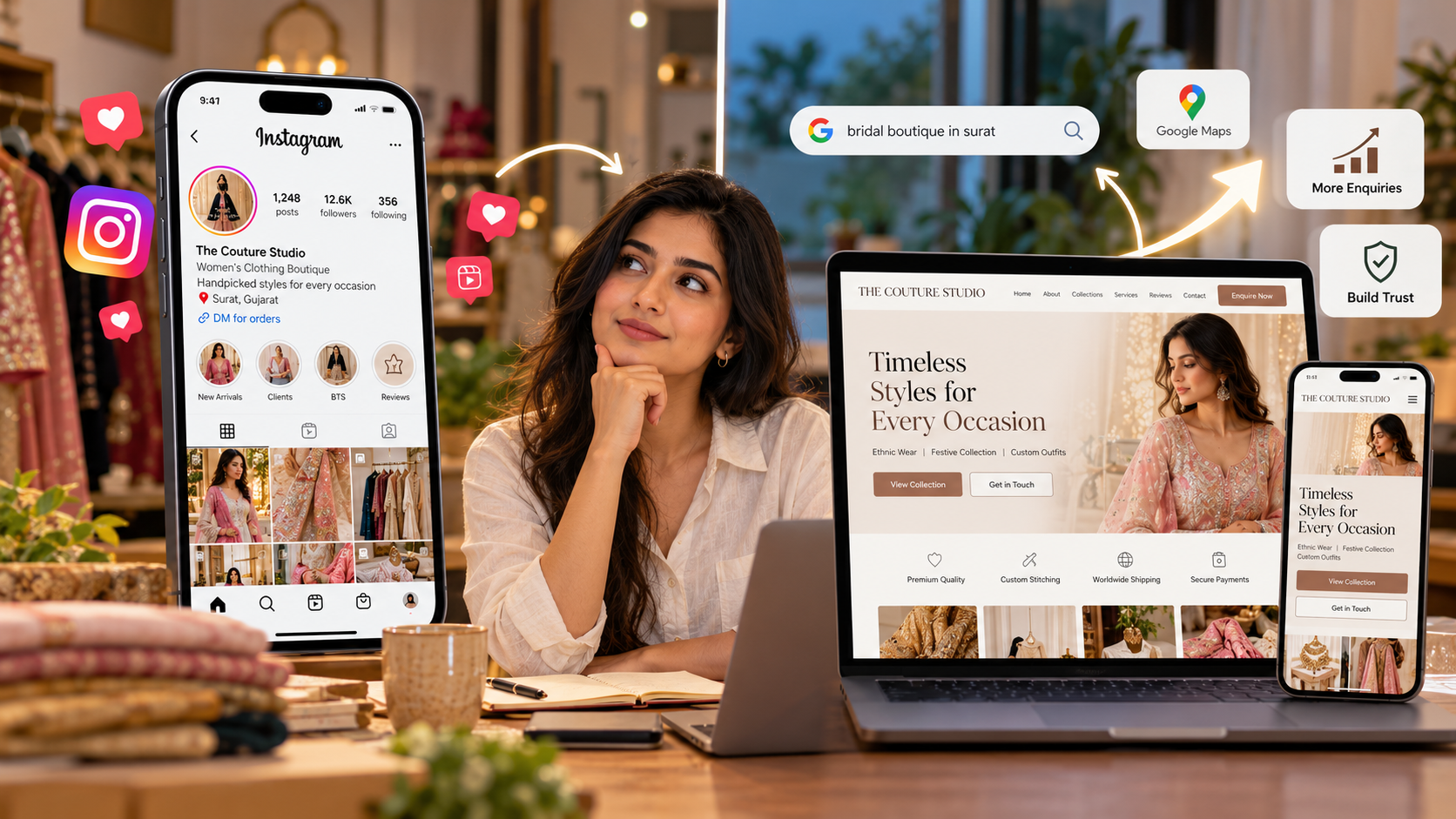
For most Indian small businesses, yes, you still need a website even if your Instagram page is doing well. Instagram is great for being discovered and staying in touch with people who already follow you, but it does not show up well when someone searches Google, you do not own it, and one algorithm change can cut your reach overnight. The smartest setup is both: Instagram to attract attention, and a website to build trust and turn that attention into enquiries.
We speak to a lot of business owners in Surat and across India who run their whole business on Instagram and WhatsApp. Many are doing well. So this is not about telling you Instagram is wrong. It is about understanding what it cannot do.
Can customers find my Instagram page on Google?
Mostly, no. When someone types "bridal boutique in Surat" or "CA near Vesu" into Google, the results are websites and Google Maps listings, not Instagram posts.
Google can index some Instagram profiles, but your posts, captions and highlights are not built to rank for what customers search. A website, on the other hand, can have a page for each service, each location and each common question, all written the way people search. That is how businesses get found by people who have never heard of them.
Think about it this way: Instagram works when people already know your name or stumble onto your content. Google works when people have a need and are actively looking for someone to solve it. Those are often your highest-intent customers.
Does a website make my business look more trustworthy?
Yes. For many customers, especially for higher-value purchases, a proper website is a trust signal that Instagram alone cannot give.
Before calling a clinic, hiring a CA, placing a bulk order with a manufacturer or paying an advance to a new supplier, people check. They look for a real address, clear services, pricing or packages, a phone number, and proof that the business is established. An Instagram page with a few hundred followers and a "DM for price" bio can make a cautious buyer hesitate.
This matters even more in B2B. A textile buyer in another state or a distributor abroad will almost always look for your website before taking you seriously.
What happens if my Instagram account gets hacked or blocked?
If your Instagram account is hacked, disabled or restricted, you can lose access to your followers, your posts and your main sales channel, sometimes for weeks, sometimes for good.
You do not own your Instagram page. You are using it under Meta's rules. Accounts get hacked through phishing messages, and accounts get restricted for reasons that are not always clear. Getting help can be slow.
A website is different. When your domain and hosting are registered in your name, it is your property. Nobody can switch it off because of a policy change or a mistaken report. Your Instagram can still be your loudspeaker, but your website should be your home address.
Why is my Instagram reach going down?
Reach goes down because the algorithm decides who sees your posts, and it changes often. What worked last year (a certain type of post, posting time or hashtag) may not work now.
This means your visibility depends on rules you do not control. Many businesses feel like they have to keep posting, keep making reels and keep paying for boosts just to stay in the same place. A website that ranks on Google for the right searches keeps bringing in enquiries even on the days you do not post anything.
What can a website do that Instagram cannot?
A website lets you control the full customer journey, from the first search to the enquiry. Specifically, it can:
Show up on Google search and support your Google Maps listing.
Your Google Business Profile works better when it links to a good website with matching details.
Explain your services properly.
Long-form pages, pricing, FAQs, process, case studies. Instagram captions are not made for this.
Capture enquiries in a structured way.
Forms, booking systems, click-to-call and WhatsApp buttons, with clear messages about what happens next.
Sell products directly.
With a cart, payment gateway, GST invoices and order tracking, instead of collecting payments over DMs.
Track what works.
With analytics, you can see where visitors come from, what pages they read and what makes them contact you.
Give you a professional email.
Something like hello@yourbrand.com builds more trust than a personal Gmail.
When is Instagram enough on its own?
Instagram alone can be enough when your customers mostly discover you through social media, your products are visual and low-ticket, and you are early in testing an idea.
Some examples where Instagram first makes sense:
A home baker or small cloud kitchen selling to local followers.
A new clothing or jewellery brand testing demand before investing more.
A creator or artist whose audience lives on Instagram.
A side business you are still validating.
Even then, we would suggest at least a free Google Business Profile so people searching locally can find you. And once you are getting regular orders, enquiries from outside your follower base, or larger customers who ask "do you have a website?", that is your sign.
How do a website and Instagram work together?
They work best as a team: Instagram brings attention, the website builds trust and converts it. Here is a simple way to set it up:
Link your website in your Instagram bio,
ideally to a page made for Instagram visitors, not just your homepage.
Show your Instagram on your website,
so visitors can see you are active and real.
Use Instagram for stories, behind the scenes and new work.
Use the website for services, pricing, FAQs and proof.
Send DM enquiries to the right page.
When someone asks "what are your charges?", send them a link to a clear page instead of typing it out every time.
Repurpose content.
A popular reel about a common question can become a website FAQ or blog post that keeps ranking on Google for years.
Keep WhatsApp as the closing tool.
A WhatsApp button on your website means people can move from reading to talking in one tap.
When done properly, the results can be significant. A CA firm we worked with, Darshan Galani & Co., signed 34 new clients within three months of launching its first website. That kind of growth comes from being findable and credible to people who were already looking.
How much does a basic business website cost?
A basic professional website in India usually costs from around ₹15,000 to ₹60,000, depending on pages, design and content. Template sites can be cheaper, and ecommerce costs more.
At Mago Labs, our packages start at ₹17,999 for a Launch site that goes live in 5 days, which suits many businesses moving beyond Instagram for the first time. You get a fixed quote before we start.
FAQ
Can I just use a Linktree instead of a website? A link page is useful for pointing followers to your WhatsApp or catalogue, but it does not rank on Google or build much trust. It works best alongside a real website, not instead of one.
Will a website help me get more Instagram followers? Indirectly, yes. Visitors who find you on Google often check your Instagram next. But the main job of the website is enquiries and sales, not followers.
I sell on WhatsApp. Do I still need a website? WhatsApp is excellent for closing sales, but people still need a way to find and trust you first. A website with a WhatsApp button gives you both.
Is a Google Business Profile enough instead of a website? It is a great free start and essential for local search. But a profile with a website link usually performs better and gives customers more information before they call.
What should my first website include? A clear homepage, a services or products page, an about page, real contact details with WhatsApp and click-to-call, and proof such as reviews or work samples.
Thinking about moving beyond Instagram?
If you are not sure whether your business needs a website yet, we will give you an honest answer. Mago Labs offers a free website audit (or a quick review of your Instagram and Google presence if you do not have a site yet). Message us on WhatsApp at +91 9099245605.